
Jul 20, 2026Field Insights
Why European Dealers Are Expanding Beyond Mobility Scooters
For European dealers, trailer manufacturers, and commercial vehicle distributors, EEC-approved electric cargo tricycles (L2e category) represent an opportunity to expand product portfolios without com
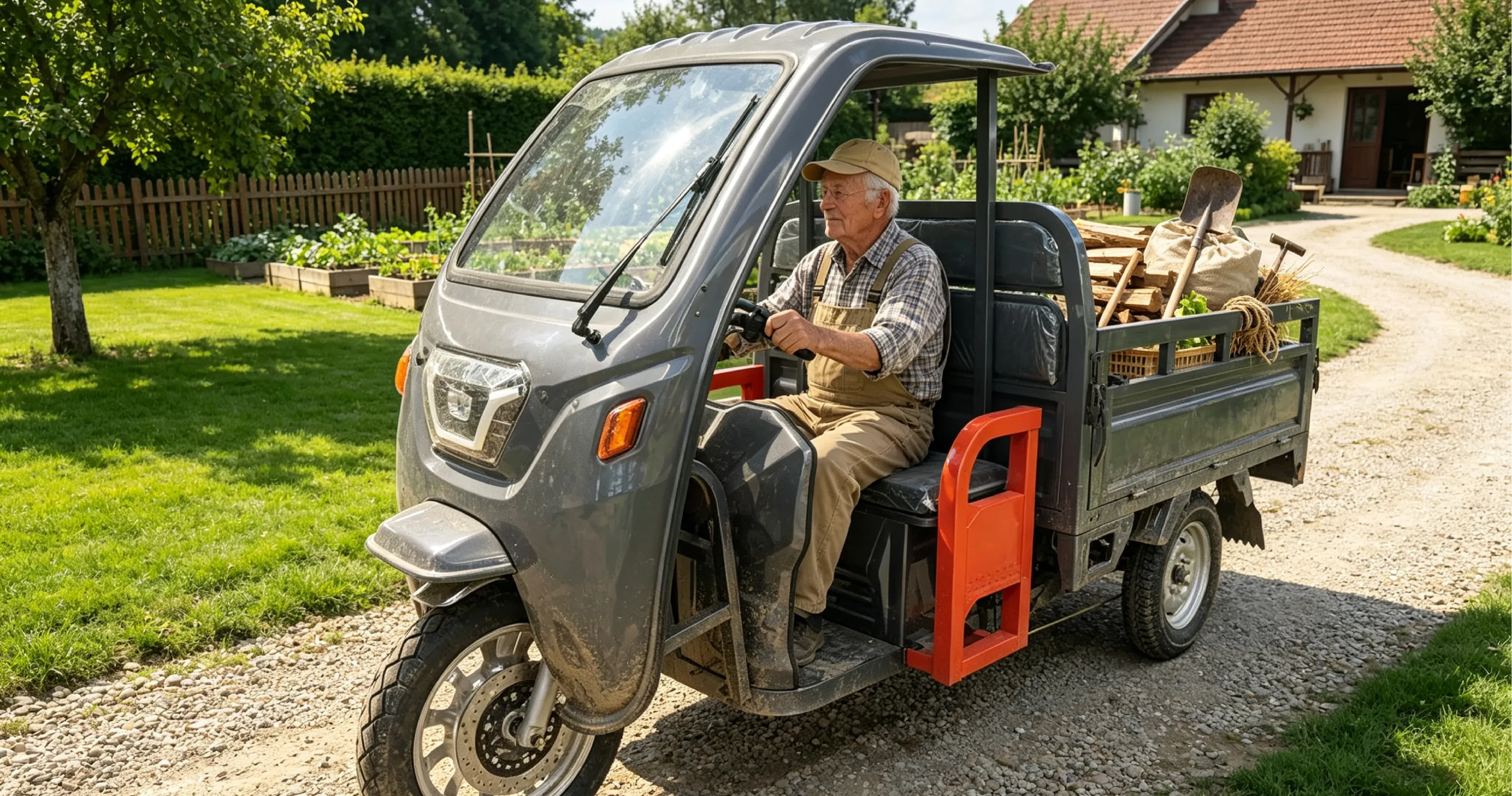
Why European Dealers Are Expanding Beyond Mobility Scooters
Introduction
The European Utility Vehicle Market Is Entering a New Phase
For decades, Europe's low-speed vehicle market has been relatively easy to define:
- Personal mobility scooters were designed to help individuals travel comfortably over short distances.
- Commercial vans and utility vehicles were built to transport goods, equipment, and maintenance crews.
Each category served a different purpose, a different customer group, and a different distribution network. Today, however, those boundaries are beginning to blur.
Across Europe, businesses, municipalities, agricultural operators, and property owners are looking for vehicles that are neither oversized commercial trucks nor basic mobility scooters. They need compact electric utility vehicles that are affordable to operate, easy to maneuver, and capable of carrying both people and cargo in everyday working environments.
At the same time, dealers are facing a different challenge. Traditional mobility scooters have become increasingly standardized. Competition is intense, price transparency has reduced retail margins, and many distributors are searching for complementary products that offer stronger differentiation and higher commercial value.
A Practical Solution for Emerging Demands
This changing landscape is creating a new opportunity. EEC-approved electric cargo tricycles are emerging as a practical solution that bridges the gap between personal mobility and light commercial transport. They allow dealers to expand into new customer segments while helping end users solve real operational problems that conventional vehicles cannot address efficiently.
Whether serving vineyards in Italy, logistics companies in Germany, resorts in Greece, municipal maintenance teams in Spain, or industrial parks across Central Europe, compact electric cargo tricycles are gradually becoming part of Europe's broader transition toward cleaner, lower-cost utility transportation.
This guide explores why this market is growing, where the commercial opportunities lie, and how European importers, dealers, and fleet buyers can successfully introduce this product category through compliant EEC models, flexible SKD/CKD solutions, and long-term partnership strategies.
Why the European Utility Vehicle Market Is Changing
The growth of electric cargo tricycles is not driven by a single industry trend. Instead, it is the result of several structural changes happening across Europe at the same time. These trends are reshaping how people, businesses, and public organizations think about short-distance transport.
1. Zero-Emission Policies Are Expanding
European cities continue to introduce stricter environmental regulations. Low-emission and zero-emission zones are becoming increasingly common, encouraging businesses to replace traditional combustion-engine utility vehicles with cleaner electric alternatives. For operators working inside cities, industrial parks, tourist destinations, campuses, and public facilities, compact electric utility vehicles provide an efficient way to reduce emissions while maintaining daily operations.
2. Rising Operating Costs Are Driving Smaller Vehicle Adoption
Fuel prices, labour costs, and vehicle maintenance expenses have all increased over recent years. Many businesses have realized that a full-size commercial van is often unnecessary for short-distance internal transportation, such as:
- Moving maintenance equipment inside a factory
- Delivering supplies across a holiday resort
- Transporting tools around municipal parks
- Carrying harvested crops inside vineyards
In these situations, a compact electric cargo vehicle often performs the same task with significantly lower operating costs. The goal is no longer simply replacing diesel with electricity; it is choosing the right-sized vehicle for the job.
3. Agriculture Is Becoming More Mechanized — But Not Everything Requires a Tractor
Across Southern Europe, thousands of farms operate in vineyards, olive groves, orchards, and greenhouses where space is limited. Traditional tractors remain essential for heavy agricultural work, but many daily transport tasks involve moving tools, fertilizers, harvested produce, irrigation equipment, or maintenance supplies over relatively short distances. Compact electric cargo tricycles provide an efficient solution for these repetitive internal transport activities while producing no local emissions and requiring minimal maintenance.
4. Internal Logistics Is Becoming a Larger Market
Many transport tasks never take place on public roads. Factories, warehouses, ports, airports, universities, hospitals, business parks, and logistics centres all rely on internal transportation every day.
These environments prioritize:
- Low operating costs & quiet operation
- Safety & easy maneuverability
- High utilization
As organizations seek to improve operational efficiency and reduce emissions, demand for purpose-built electric utility vehicles continues to increase.
5. Dealers Need New Growth Categories
Perhaps the most important trend is happening inside dealerships themselves. Many distributors report that traditional mobility scooters have become increasingly difficult to differentiate. Customers compare specifications online, price competition continues to intensify, and margins become thinner every year.
For many dealers, expanding into electric cargo tricycles is not simply about adding another vehicle; it is about creating a new business category. Instead of competing solely on battery capacity or retail price, dealers can offer practical utility solutions for agriculture, municipalities, property maintenance, logistics, hospitality, and industrial applications—markets where operational value often matters far more than small differences in purchase price.
The Hidden Gap Between Mobility Scooters and Commercial Vehicles
A Story That Reflects a Bigger Trend
A dealer in rural France recently shared an interesting customer story. One of his long-term customers had modified a standard mobility scooter with a homemade cargo platform to transport firewood, gardening tools, and bags of soil.
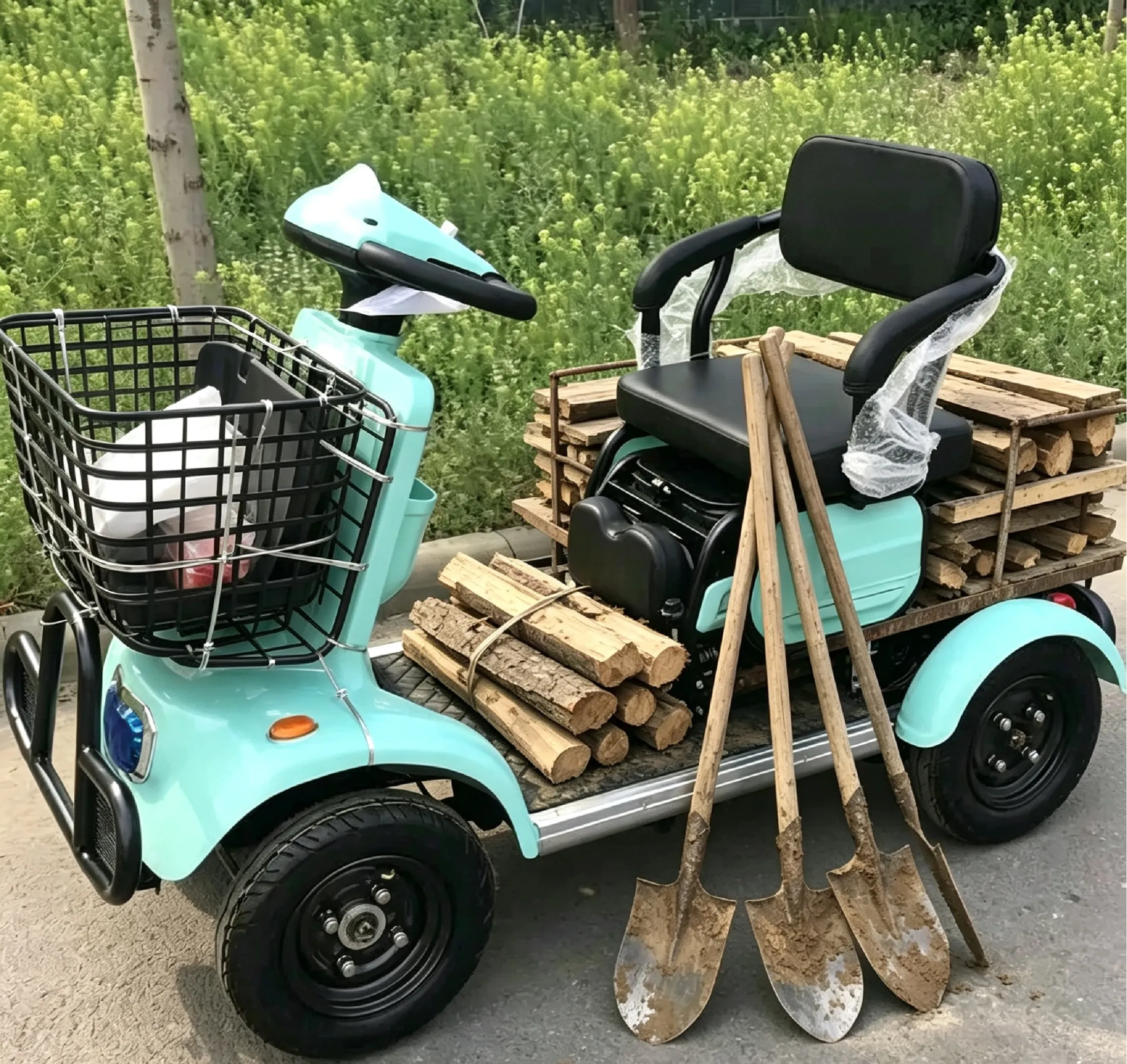
When asked why, his answer was simple:
"The scooter helps me move. It doesn't help me work."
Although this is only one example, it reflects a much larger trend across Europe. Many customers no longer need a vehicle solely for personal mobility. They need a compact vehicle that combines mobility with practical utility.
�Key Market Insight
The market isn't asking for a better mobility scooter. It's asking for an entirely new utility vehicle category.
Where Is the Gap?
Feature | Traditional Mobility Scooter | Electric Cargo Tricycle | Commercial Utility Vehicle |
Primary Use | Personal transportation | Mobility + Cargo | Heavy-duty transport |
Cargo Setup | Small basket | Large cargo bed | Large cargo bed / Van box |
Payload | Low payload | Medium payload (200kg-400kg+) | High payload |
Environment | Indoor / Community | Mixed environments / Narrow roads | Commercial sites / Highways |
Design Focus | Comfort-focused | Utility-focused | Productivity-focused |
Target Sector | Limited applications | Multiple industries (B2C & B2B) | Professional operations |
A Different Buying Decision
Instead of comparing battery capacity or top speed, buyers increasingly ask practical questions:
✔ Can it carry my tools?
✔ Will it fit through my greenhouse gate?
✔ Can it reduce labour?
✔ Can my staff operate it safely?
✔ Can it replace two vehicles?
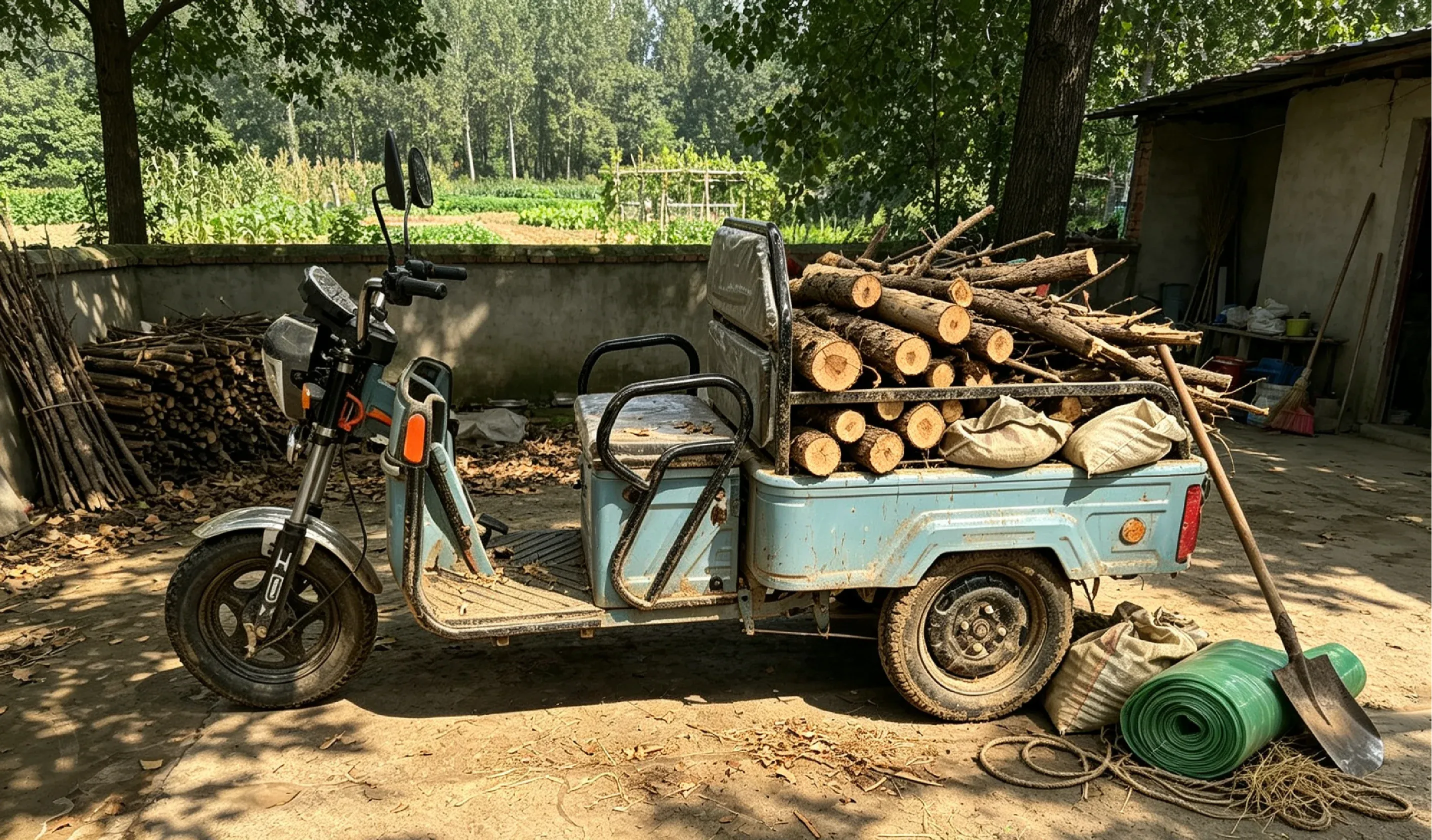
How Buying Criteria Are Changing
Yesterday | Today |
How fast is it? | Can it improve productivity? |
How far can it travel? | Can it carry equipment and cargo safely? |
How much is it? | Will it reduce our daily operating costs? |
Is the battery larger? | Does it solve my daily on-site work? |
Demand Is Coming From More Than One Industry
Industry | Typical Daily Tasks | Why Electric Cargo Tricycles Fit |
Agriculture | Tools, fertilizer, vineyard harvest | Narrow access (860-960mm width), low operating cost |
Municipalities | Park maintenance, waste cleaning | Quiet operation, zero emissions in green zones |
Resorts | Housekeeping, laundry, luggage | Silent operation, non-intrusive to guests |
Industrial Parks | Internal parts & tool logistics | Flexible movement inside/outside workshops |
Warehouses | Short-distance package transport | Efficient, economical, zero indoor fumes |
Property Maintenance | Gardening, hedge trimming, maintenance | Compact design, versatile cargo box options |
�Dealer Benefits
✅ Add a highly differentiated product category
✅ Reduce direct online price competition
✅ Expand from B2C into lucrative B2B accounts
✅ Increase Average Order Value (AOV)
✅ Stand out clearly from traditional competitors
The next question is no longer whether dealers should introduce electric cargo tricycles. It is which platform best fits different commercial applications. In the next section, we'll compare compact and heavy-duty cargo platforms designed for European markets.
Building a Successful Electric Cargo Tricycle Business
1. Choosing the Right Product Platform
Rather than offering one vehicle for every application, successful dealers build a product portfolio that matches different customer needs.
Which Platform Fits Your Market?
Product Platform | Key Dimensions (Box) | Typical Customers | Typical Applications | Why It Works |
Compact Cargo Series | Length: 1.1m / 1.2m Width: 860mm / 960mm | Mobility Dealers, Premium Estate Owners | Gardens, estates, narrow greenhouses | Ultra-Narrow Access: Slips through standard gates and tight historical lanes effortlessly. |
Standard Cargo Series | Length: 1.5m Width: 1.18m | Agricultural Dealers, Hobby Farmers | Small farms, orchards, vineyard rows | Optimal Balance: Fits standard Euro agricultural crates with a stable wheel track. |
Heavy-Duty Series | Length: 1.6m Width: 1.18m | Fleet Buyers, B2B Procurement | Municipalities, resorts, industrial logistics | High Productivity: Max volume payload for commercial operations and heavy waste/linen tools. |
2. SKD or CKD? Selecting Your Import Strategy
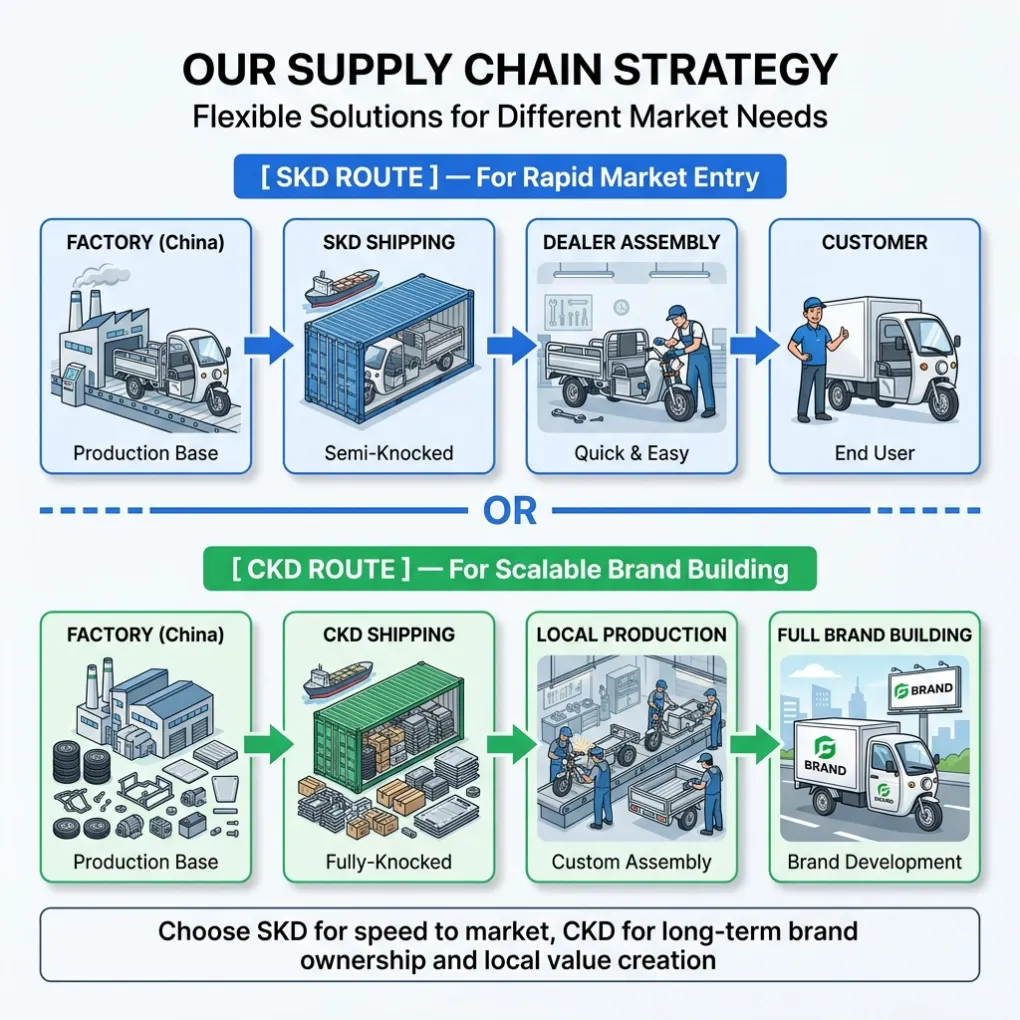
SKD vs CKD Comparison
Feature | SKD (Semi-Knocked Down) | CKD (Completely Knocked Down) |
Shipping Cost | Lower (Optimized container space) | Lowest (Maximum packing density) |
Assembly Required | Simple (Front wheel, handlebars, accessories) | Complete (Chassis, wiring, body components) |
Initial Investment | Low (Basic workshop tools) | Medium (Assembly line, testing equipment) |
Local Value Addition | Limited | High (Qualifies for local assembly/tariffs) |
Suitable For | New Dealers / Rapid Market Testing | Established Importers / Large Fleet Buyers |
OEM Branding Opportunity | Basic (Logo & decals) | Full (Custom color, components, local branding) |
3. Understanding EEC Compliance & Homologation
Regulatory compliance is the bedrock of a sustainable low-speed vehicle business in Europe. Depending on the target country, vehicles must comply with appropriate frameworks (such as L2e-U for three-wheel light utility cargo or L5e-B for heavy cargo tricycles) to access public roads and institutional tenders.
Documents Required for European Registration
Document | Why It Matters |
EEC Type Approval | Verifies whole-vehicle safety, environmental, and technical homologation under EU standards. |
CoC (Certificate of Conformity) | Delivered with each specific vehicle to allow immediate local plating and road registration. |
VIN (Vehicle Identification Number) | Stamped structural ID required for insurance, tracking, and national database registry. |
WMI (World Manufacturer Identifier) | Verifies the legal, traceable manufacturing source of the underlying platform. |
User Manual | Mandated safety, operational, and maintenance documentation in local languages. |
Note: Depending on each country's specific transport regulations, additional local road registration and insurance requirements may apply.
What Dealers Usually Ask Before Their First Order
❓ Can I start with one container?
Yes. Many dealers begin by testing their local market's feedback with a single container (trial order) before expanding into scheduled multi-container rolling forecasts.
❓ Can I use my own brand name?
Yes. Full OEM branding, custom color schemes, and localized decal packages are available for qualified distribution partners.
❓ Can you provide official EEC documents?
Yes. All applicable European models are supplied with the corresponding whole-vehicle EEC type approval certificates and CoC documents for seamless dealer-side registration.
❓ Do you support SKD shipping?
Yes. We support both SKD and CKD packaging structures depending on your local technical setup, import tariff benefits, and assembly capabilities.
Why Dealers Work With Us ?
��️ Dealer Support Includes:
✅ EEC-approved product platforms (L2e-U category layouts)
✅ Flexible SKD & CKD logistical shipping solutions
✅ Comprehensive OEM branding & customized color systems
✅ Complete Technical documentation & electrical wiring diagrams
✅ Structured Spare parts planning & emergency support
✅ Reliable production scheduling & engineering consultation
✅ Full export documentation for smooth European customs clearance
Rather than simply supplying vehicles, we work hand-in-hand with distributors to help them build highly sustainable, high-margin electric utility vehicle businesses in their local markets.
Ready to Explore the European Utility Vehicle Market?
Whether you are:
- A mobility scooter dealer looking for higher margins
- A trailer manufacturer expanding into powered platforms
- An agricultural equipment distributor targeting narrow orchards
- A municipality supplier moving toward zero emissions
- A B2B fleet buyer optimizing resort logistics
Our technical and export teams can help you evaluate the right product platform, import packaging strategy, and compliance solution for your target territory.
Related Articles