
Sep 22, 2026Field Insights
Europe Electric Utility Tricycles: Industry Outlook, L2e/L5e Regulations & B2B Sourcing
Discover the 2026 European electric cargo tricycle market guide: L2e-U/L5e-B EEC regulations, CoC compliance, key B2B applications in agriculture & last-mile logistics, and country breakdown.
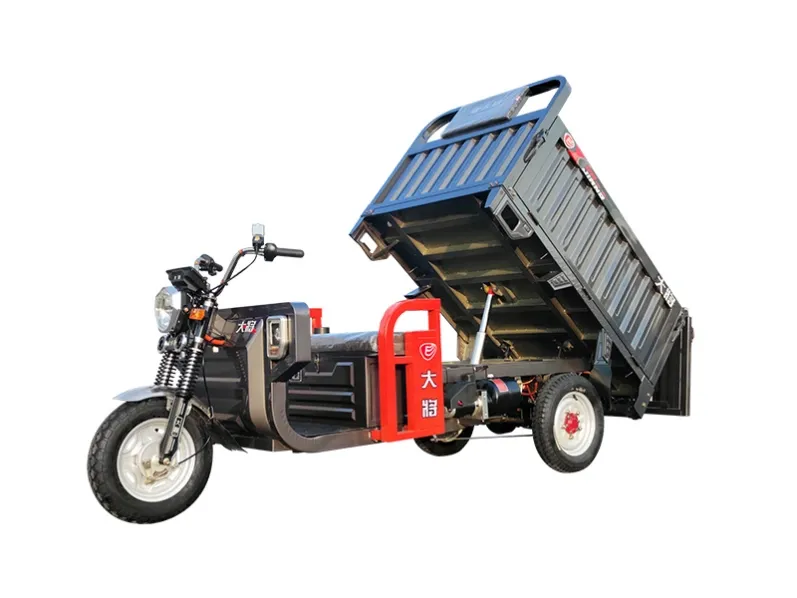
The European Electric Cargo Tricycle Market: Industry Overview, Applications, and Regulatory Framework
1. Introduction: The European Electric Cargo Tricycle Market
Electric cargo tricycles are becoming an increasingly visible part of Europe's broader transition toward low-emission, cost-effective, and flexible commercial transport.
Designed primarily for carrying goods, tools, and equipment, these three-wheel electric vehicles occupy a strategic niche between traditional cargo e-bikes and conventional light commercial vehicles (LCVs). They combine the compact footprint and maneuverability of a light vehicle with a dedicated heavy-duty cargo platform built for practical daily operations.
Their applications extend far beyond traditional urban last-mile delivery. Depending on vehicle configuration, payload capacity, and national road regulations, electric cargo tricycles are deployed across:
- Agricultural & Viticulture: Moving harvesting crates, tools, and fertilizers through narrow farm tracks and vineyard rows.
- Facility Maintenance & Landscaping: Transporting machinery across municipal parks, university campuses, and residential estates.
- Industrial Site Logistics: Moving spare parts, tools, and components within large factories and multi-building plant grounds.
- Hospitality & Resort Management: Quietly carrying luggage, linen, and supplies in noise-sensitive and pedestrian-friendly zones.
- Municipal Services: Supporting urban waste collection, street cleaning, and public infrastructure maintenance.
Vehicle Category | Typical Strengths | Primary Limitations | Common European Use Cases |
Cargo E-Bike | Highly maneuverable, fits cycle paths, no license required | Low payload (<200 kg), limited cargo volume, weather exposure | Food delivery, small parcel post, inner-city micro-logistics |
Electric Cargo Tricycle | High payload (300–1,500 kg), low TCO, versatile cargo platforms | Restricted highway capability, moderate top speeds (25–45 km/h) | Last-mile delivery, agriculture, site maintenance, municipal fleets |
Small Electric Commercial Vehicle (e-Quadricycle / L7e) | Enclosed cabin, higher road speed | Higher acquisition cost, wider footprint in tight spaces | Urban trade services, small business deliveries, light municipal duties |
Light Commercial Van (N1 Category) | Maximum payload, weatherproofing, long-distance range | High purchasing/operating cost, urban access restrictions, parking challenges | Regional logistics, heavy trade services, inter-city transport |
2. European Market Drivers & Operating Dynamics
Demand for electric cargo tricycles across Europe is driven by structural shifts in urban logistics, commercial fleet electrification, operating-cost management, and environmental mandates.
Key Drivers Accelerating Adoption
- Urban Access & Low-Emission Zones (LEZs): With over 300 European cities implementing Zero-Emission Zones (ZEZs) and traffic-calming measures, businesses require compact, zero-tailpipe-emission vehicles to access city centers without penalty.
- Total Cost of Ownership (TCO) Optimization: Commercial operators benefit from significantly lower energy costs per kilometer, reduced brake and drivetrain wear, and lower routine maintenance costs compared to internal combustion engine (ICE) vans.
- Off-Road & Short-Distance Utility Demand: In non-urban environments—such as vineyards in Italy, orchards in Poland, or industrial plants in Germany—maneuverability and payload capacity take priority over highway speed.
3. Regulatory Framework: L-Category Homologation in the EU
To legally operate an electric cargo tricycle on public roads within the European Union, the vehicle must comply with European type-approval standards under Regulation (EU) No 168/2013.
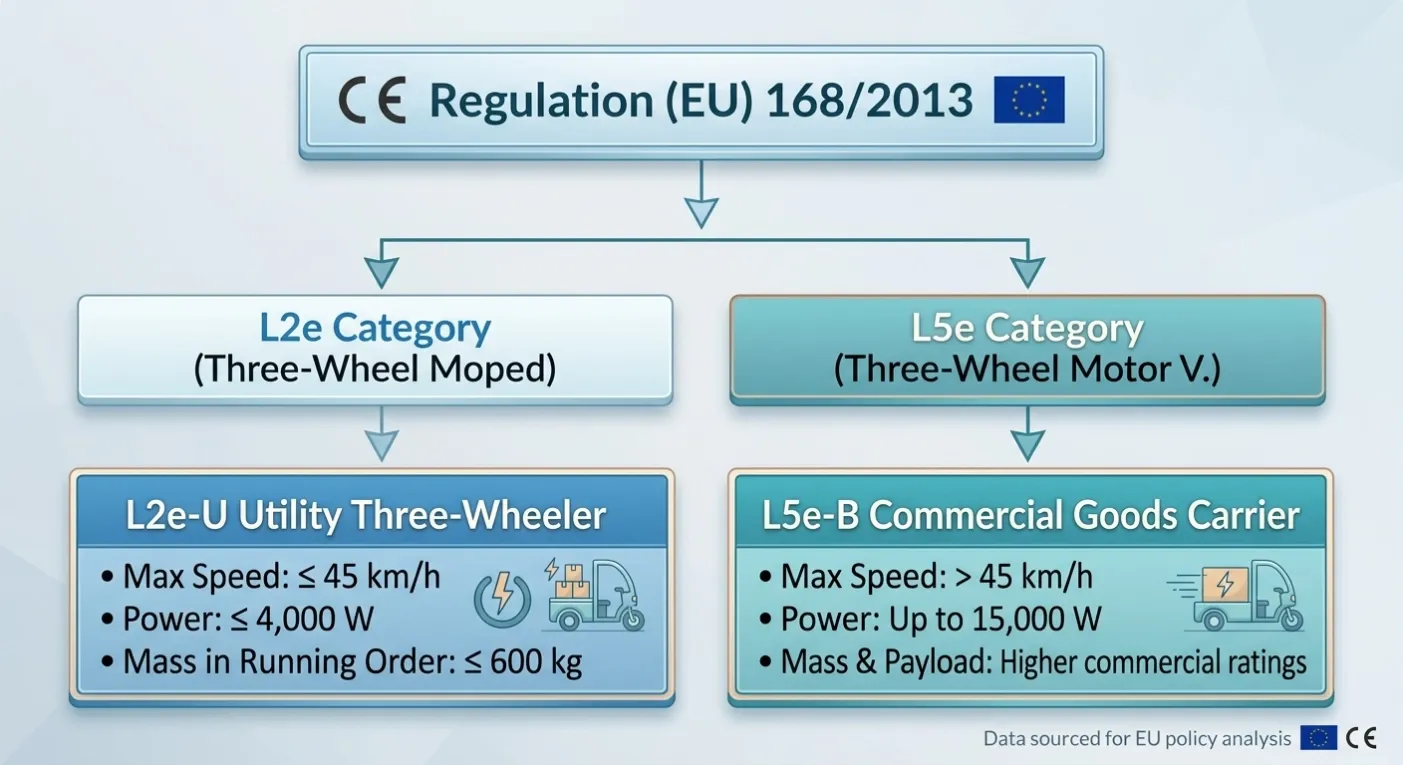
Critical Homologation Parameters (L2e-U vs. L5e-B)
L2e-U (Utility Three-Wheel Moped):
- Speed Limit: Maximum design speed $\le 45\text{ km/h}$.
- Power Limit: Continuous rated power $\le 4\text{ kW}$.
- Use Case: Urban micro-delivery, light municipal work, local farm transport.
L5e-B (Commercial Utility Three-Wheel Motor Vehicle):
- Speed Limit: Speeds exceeding $45\text{ km/h}$.
- Power Limit: Power output up to $15\text{ kW}$.
- Use Case: Heavy cargo delivery, suburban utility transport, heavier payload capacity.
Crucial Compliance Requirement for Importers & Distributors
Vehicle modification post-homologation (such as upgrading the controller, changing battery chemistry, or altering cargo bed dimensions) can invalidate the original Certificate of Conformity (CoC). Ensure that any structural or electrical customization is fully documented and approved under EU type-approval extensions before placing vehicles on the market.
Additional EU Compliance Checklist
- Certificate of Conformity (CoC): Essential for national vehicle registration across all EU member states.
- EU Battery Regulation (EU 2023/1542): Mandatory compliance covering battery safety, CE marking, material sourcing, and end-of-life recycling requirements.
- Functional Safety Standards: Strict technical compliance regarding braking systems, lighting fixtures, rear-view visibility, and chassis structural integrity.
4. Key Procurement Criteria for European B2B Buyers
To successfully deploy or distribute electric cargo tricycles in Europe, commercial buyers and distributors evaluate vehicles based on a balance of legal compliance, operational efficiency, and long-term product durability.
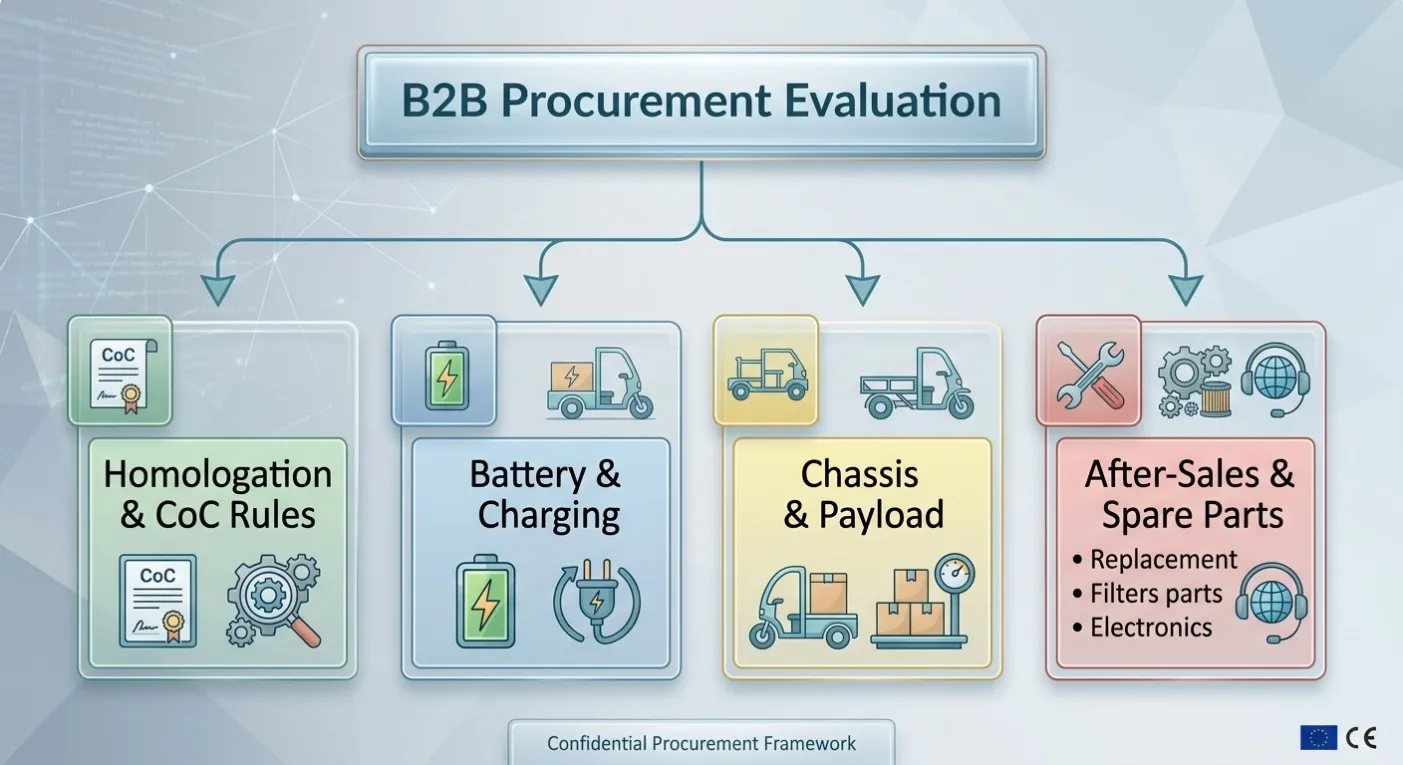
- Homologation Integrity: Ensuring the vehicle comes with a valid European Certificate of Conformity (CoC) matching the exact production specification (L2e-U or L5e-B).
- Battery Technology & Safety Compliance: Compliance with EU Battery Regulation (EU 2023/1542), preferred lithium chemistries (LFP for cycle life and safety), and flexible charging methods (standard 230V AC socket charging vs. removable battery swaps).
- Cargo Bed Modularization: Availability of versatile rear configurations—such as hydraulic tippers, enclosed box vans, flatbeds with drop-sides, or insulated cooler boxes—tailored to specific end-user operations.
- Spare Parts Availability & Maintenance: Local support for high-wear components (brake pads, tires, controllers, suspensions, and drive shafts) to minimize fleet downtime.
5. Strategic Outlook: The Future of Electric Cargo Transport in Europe
As European national governments tighten urban emission controls and incentivize rural decarbonization, the electric cargo tricycle segment is poised for significant structural growth over the coming decade.
Key trends shaping the next generation of light utility vehicles include:
- Integration of Smart Telematics: Fleet operators increasingly demand IoT-enabled controllers for real-time GPS tracking, battery State-of-Health (SoH) monitoring, and remote diagnostics.
- Shift Toward Modular Supply Formats (CKD/SKD): European distributors are increasingly looking for Semi-Knocked-Down (SKD) or Completely Knocked-Down (CKD) packaging models to optimize shipping logistics, reduce import tariffs, and enable local final assembly.
- Expansion in Non-Urban Sectors: While urban last-mile delivery remains a major market driver, high-growth opportunities are rapidly accelerating in agricultural modernization, municipal park management, and resort logistics.
6. Country-by-Country Market Analysis (Series Directory)
The European market is diverse. A vehicle configuration optimized for agricultural operations in Southern Europe may differ significantly from an urban delivery tricycle designed for Northern European logistics networks.
To explore detailed local market dynamics, commercial buyer profiles, regulatory specifics, and incentive structures, select a country guide below:
Region | Country | Primary Applications | Market Profile & Guides |
Western Europe | Germany | Industrial sites, municipal services, urban delivery | [Link coming soon] |
Netherlands | Last-mile urban logistics, zero-emission city hubs | [Link coming soon] | |
France | Agriculture, municipal services, postal logistics | [Link coming soon] | |
Southern Europe | Italy | Viticulture, agricultural transport, narrow urban streets | [Link coming soon] |
Spain | Municipal sanitation, resorts, fruit & olive harvesting | [Link coming soon] | |
Greece | Island hospitality, resort logistics, agricultural utility | [Link coming soon] | |
Eastern Europe | Romania | Rural transport, smallholder agriculture, local delivery | [Link coming soon] |
Poland | Manufacturing logistics, agricultural transport, urban post | [Link coming soon] | |
Bulgaria | Agricultural operations, utility, light commercial transport | [Link coming soon] | |
Northern Europe | Denmark / Sweden | Urban micro-hubs, municipal park care | [Link coming soon] |