
Oct 12, 2026Risk & Compliance
Electric Cargo Tricycles in Turkey 2026: Industrial, Agricultural and Logistics Market Guide
A B2B guide to electric cargo tricycles in Turkey for OSB factories, automotive suppliers, farms, greenhouses, warehouses, hotels and logistics operations. Covers applications, regional markets, vehic
Electric Cargo Tricycles in Turkey 2026: Industrial, Agricultural and Logistics Market Guide
A practical B2B guide to Turkey’s industrial, agricultural, logistics and commercial applications
Quick Answer
In Turkey, electric cargo tricycles operate primarily as industrial and agricultural utility vehicles (Intralogistics) rather than last-mile delivery vans. Demand is concentrated in Organized Industrial Zones (OSBs) across Marmara (Kocaeli/Bursa) for factory logistics, and Mediterranean/Central Anatolia (Antalya/Konya) for greenhouse and farm transport. While Turkey aligns its L-category type-approval with EU Regulation 168/2013, public-road registration requires specific Turkish approval.
Turkey is not simply another European market for electric cargo tricycles.It is a large manufacturing and agricultural economy with significant industrial zones, automotive production, logistics infrastructure, tourism and regional trade. For commercial vehicle distributors, the opportunity is not limited to urban delivery.The most relevant applications are often short-distance, repetitive transport inside:
- Organized Industrial Zones (OSBs)
- factories and automotive plants
- warehouses
- farms and orchards
- greenhouses
- food-processing facilities
- hotels and resorts
- construction sites
- logistics and controlled industrial areas
In these environments, a compact electric cargo tricycle can be evaluated as an alternative to a small van, pickup, forklift, trolley or manual transport for specific repetitive tasks.
Turkey also has its own vehicle approval and registration framework. Its L-category type-approval rules are developed in alignment with the EU framework based on Regulation (EU) 168/2013, but EU Type Approval should not be treated as automatic Turkish road-use authorization. Public-road applications require the applicable Turkish classification, approval and registration route to be established for the specific vehicle.
For B2B buyers, therefore, the key questions are:What needs to be transported, where does it move, how often does it move, and what vehicle is currently doing the job?
1. Why Is Turkey Relevant for Electric Cargo Tricycles?
Turkey has a particularly strong combination of manufacturing, agriculture and logistics.Its automotive industry produced about 1.42 million vehicles in 2025, and Turkey ranked first in Europe for commercial vehicle production that year. The country also has a large supplier base, including more than 530 Tier-1 suppliers and 169 automotive R&D and design centers as of June 2026.
This matters because large manufacturing ecosystems create many internal transport tasks.A factory does not only move finished products.
It also moves:components,packaging,tools,spare parts,work-in-process materials,maintenance supplies,empty containers,quality-control items.Many of these movements are short and repetitive.The same logic applies to agriculture.Farms, greenhouses and packing facilities continuously move:crates,harvestedproducts,tools,irrigation,materials,packaging,feed,maintenance equipment.This creates a potential role for a compact electric cargo vehicle.
The commercial opportunity is therefore less about selling a generic “electric three-wheeler” and more about solving specific short-distance transport problems.
2. Organized Industrial Zones: One of Turkey's Most Relevant B2B Environments
Turkey's Organized Industrial Zones, locally known as OSB (Organize Sanayi Bölgesi), are particularly relevant to electric cargo tricycle applications.OSBs concentrate factories, warehouses, workshops, suppliers and industrial service companies within defined industrial areas.
According to Turkey's Ministry of Industry and Technology (Sanayi ve Teknoloji Bakanlığı), the country had 373 OSBs, around 61,000 operating factories and approximately 2.7 million employees in OSBs by 2026.
For a cargo-tricycle distributor, the significance is not simply the number of industrial zones.It is the concentration of repetitive transport activities.A factory may need to move materials between:warehouse and production line,production line and quality-control area,spare-parts store and maintenance department,packaging area and dispatch area,workshop and production building.
- A full-size van may be excessive for these movements.
- A forklift may not be appropriate for every load.
- Manual carts may be too slow across a large industrial site.
This is where a compact electric cargo tricycle can be evaluated as internal logistics equipment.
What should a distributor ask an OSB customer?
Instead of starting with:“Do you need a 1500W electric tricycle?”Start with:“What do you move every day, how far does it move, how many trips are required, and what are you using now?”That question connects the vehicle to an actual operating problem.
3. Where Are the Main Commercial Opportunities?
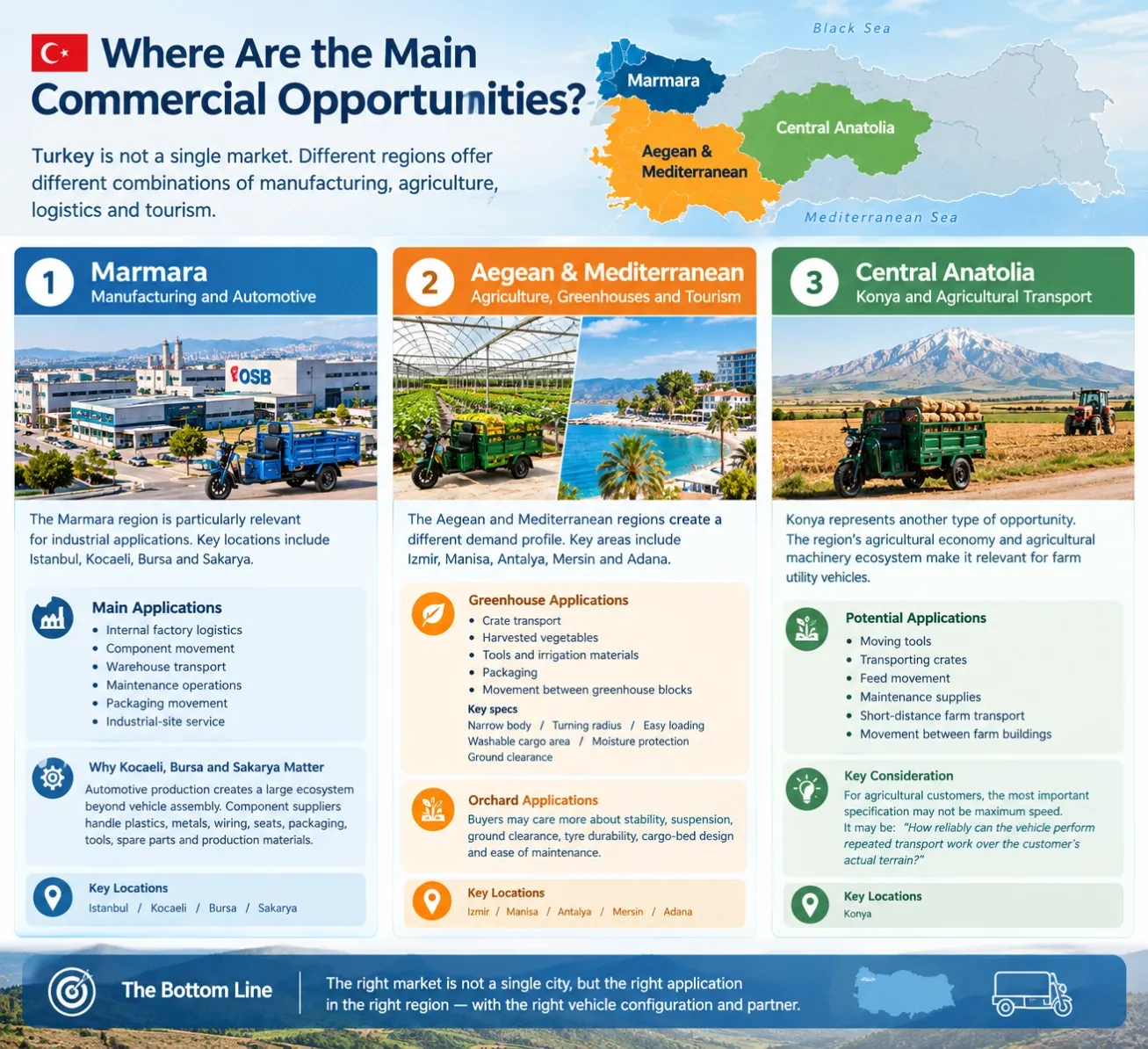
Turkey should not be treated as one uniform market.Different regions have different combinations of manufacturing, agriculture, logistics and tourism.
Marmara: Manufacturing and Automotive
The Marmara region is particularly relevant for industrial applications.Key locations include:Istanbul,Kocaeli,Bursa,Sakarya.The region contains major automotive and manufacturing activities, supplier networks, warehouses and logistics operations.
For electric cargo tricycles, the relevant applications are mainly:internal factory logistics,component movement,warehouse transport,maintenance operations,packaging movement,industrial-site service.
Why Kocaeli, Bursa and Sakarya matter
Automotive production creates a large ecosystem beyond vehicle assembly. Component suppliers may handle:plastic parts,metal components,wiring,seats,packaging,tools,spare parts,production materials.These environments can create continuous short-distance movements between buildings and work areas.
For an industrial distributor, this makes the Marmara manufacturing corridor an important area to investigate.
Aegean and Mediterranean Turkey: Agriculture, Greenhouses and Tourism
The Aegean and Mediterranean regions create a different demand profile.Relevant areas include:Izmir,Manisa,Antalya,Mersin,Adana
Izmir combines manufacturing, logistics, agriculture and port activity. Turkey's Ministry of Industry and Technology currently reports 14 OSBs in Izmir.Further south, agriculture and greenhouse operations become increasingly relevant.
Greenhouse applications
Electric cargo tricycles can be evaluated for:crate transport,harvested vegetables,tools,irrigation materials,packaging,movement between greenhouse blocks.Important specifications may include:narrow body dimensions,turning radius,easy loading,washable cargo area,moisture protection,suitable ground clearance.
Orchard applications
For farms and orchards, buyers may care more about:stability,suspension,ground clearance,tyre durability,cargo-bed design,ease of maintenance.
The correct configuration depends on the actual terrain and duty cycle rather than simply being labeled an “agricultural model.”
Central Anatolia: Konya and Agricultural Transport
Konya represents another type of opportunity.The region's agricultural economy and agricultural machinery ecosystem make it relevant for farm utility vehicles.
Potential applications include:moving tools,transporting crates,feed movement,maintenance supplies,short-distance farm transport,movement between farm buildings.
For agricultural customers, the most important specification may not be maximum speed.It may be:How reliably can the vehicle perform repeated transport work over the customer's actual terrain?
4. What Are the Main Commercial Applications?
The following table provides a practical way to match the Turkish market with vehicle applications.
Application Sector | Target Customer | Typical Transport Task | Recommended Vehicle Spec | Key Technical Priority |
OSB Factory Logistics | Tier-1 Automotive & Machinery | Heavy components, tooling, empty containers | Heavy-duty flatbed, 800-1200kg payload | High-torque motor, reinforced chassis |
Greenhouse & Agriculture | Antalya Growers, Konya Farms | Crates, harvested produce, irrigation gear | Narrow body (<1.1m width), 300-500kg payload | Small turning radius, moisture/dust proofing (IP65) |
Resorts & Facilities | Mediterranean Hotels, Campuses | Towels, waste, housekeeping, maintenance | Enclosed/Lockable cargo box, quiet electric drive | Low noise, non-marking tires, clean aesthetics |
The most attractive applications tend to share several characteristics:short travel distance,frequent trips,predictable routes,repeated loading and unloading,limited need for high speed,high value placed on maneuverability,measurable operating costs
This is why internal logistics deserves more attention than simply focusing on last-mile delivery.
5. Hotels and Resorts: A Different Commercial Use Case
Turkey's tourism industry creates another potential application for electric cargo tricycles.Large hotels, resorts and campgrounds often function like small private communities.They may need frequent movement of:laundry,housekeeping supplies,maintenance tools,landscaping materials,kitchen supplies,waste,spare parts.
Here, a cargo tricycle can be evaluated as a site-mobility and service vehicle.The priorities may be different from an industrial customer.A hotel may care more about:quiet operation,compact dimensions,clean appearance,covered cargo,easy loading,low-speed maneuverability.
If the vehicle operates exclusively within private property, the application should be evaluated as site logistics.If it enters public roads, the applicable Turkish road-use and registration requirements become relevant.
Passenger transport should not be assumed simply because a vehicle has three wheels. Any passenger use must correspond to the vehicle's approved configuration and applicable local requirements.
6. Which Vehicle Configuration Fits the Turkish Market?
There is no single “Turkey electric cargo tricycle.”A more practical approach is to use several application-oriented configurations.
Industrial Configuration
Suitable for:factories,OSBs,automotive suppliers,warehouses,maintenance operations.
Typical priorities:durable cargo platform,practical loading height,reliable braking,robust suspension,durable tyres,weather protection where required,easy maintenance.The main KPI is often uptime and cost per useful trip.
Agricultural Configuration
Suitable for:farms,orchards,agricultural dealers,greenhouse operations.Typical priorities:stable cargo platform,suitable ground clearance,durable tyres,practical cargo-bed design,dust and moisture protection,easy charging,simple maintenance.
The configuration should be based on the actual terrain, load and daily operating pattern.
Commercial and Service Configuration
Suitable for:hotels,resorts,campuses,facility-management companies,commercial properties,construction sites.Typical priorities:compact dimensions,quiet operation,covered or lockable cargo,easy loading,clean appearance,practical service equipment.The same basic vehicle platform can therefore serve different sectors without pretending that every customer has identical requirements.
7. What Is the Commercial Case?
The business case for an electric cargo tricycle is primarily operational.Environmental benefits may support the purchase, but commercial customers normally need to understand what the vehicle changes in their daily operation.A useful evaluation should compare the tricycle with the current transport method.That may be:a small van,a pickup,a forklift,a manual trolley,another utility vehicle,manual labour.
Key metrics
Metric | What to Measure |
Trips per day | How frequently the vehicle is used |
Distance per trip | Typical operating distance |
Cargo | Weight and type of material |
Labour | Operator time |
Energy | Electricity or fuel cost |
Loading time | Time spent per trip |
Maintenance | Routine and unexpected costs |
Downtime | Lost operating time |
Charging | Time and infrastructure required |
Terrain | Asphalt, gravel, slopes, dust, rain |
For B2B customers, a more useful question than purchase price alone is:What does each useful transport trip cost?If the vehicle can perform many short trips with low downtime and simple maintenance, the business case can be stronger than a coInternal Logistics Cost Example (OSB Factory):
Compared to a conventional 1.5L diesel pickup moving spare parts 15-20 times daily within a 5km OSB site:
- Energy Cost: Electric cargo tricycles reduce daily charging costs by up to 75–80% compared to diesel fuel in Turkey.
- Maintenance: Eliminating engine oil, clutches, and complex transmission systems lowers routine maintenance costs by ~60%.
- Payback Period: For an OSB facility operating 2 shifts/day, the lower operational expense typically recovers the vehicle's initial purchase cost within 8 to 12 months.mparison based only on the initial vehicle price.
8. Turkey Compliance: Public Roads vs Private Sites
This is one of the most important distinctions for the Turkish market.Turkey has a specific type-approval framework for two- and three-wheel motor vehicles and four-wheel motorcycles. The Turkish regulation is explicitly aligned with the EU regulatory framework based on Regulation (EU) 168/2013. Recent amendments to this Turkish regulation continued to reference the EU framework.
Therefore, two statements should be avoided:“EU Type Approval is useless in Turkey.”and:“EU Type Approval automatically makes a vehicle road-legal in Turkey.”Neither is sufficiently accurate.The practical position is:
EU Type Approval can provide useful technical documentation and demonstrate conformity with a European regulatory framework, but Turkish public-road use still depends on the applicable Turkish classification, approval and registration requirements.
For public-road applications
A distributor should establish:applicable vehicle category,Turkish type-approval ,route registration requirements,insurance requirements,required vehicle equipment,driver requirements,inspection requirements,whether the exact configuration can be registered,whether local modifications affect the approved configuration.
For private-site applications
A vehicle opeating only inside:
factories,warehouses,farms,greenhouse,hotels,construction sites,controlled logistice facilities.many have a different operating context from a public-road vehicle. However, private-site use does not mean “no requirements.”
Site operators may still impose rules concerning:speed,lighting,operator training,battery safety,charging,insurance,site traffic,access control.For many B2B customers, this distinction can significantly affect the vehicle-selection process.
9. Who Should Distribute Electric Cargo Tricycles in Turkey?
The best distribution partner is not necessarily a traditional motorcycle dealer.For commercial applications, several types of companies may be more relevant.
Industrial Equipment Dealers
Companies already selling:forklifts,warehouse equipment,pallet trucks,industrial machinery,material-handling equipment.already understand B2B purchasing and factory operations.The cargo tricycle becomes an additional tool for short-distance material transport.
Agricultural Machinery Dealers
Agricultural machinery dealers can introduce electric utility vehicles to:farms,orchards,greenhouse operators,agricultural contractors.
The vehicle should be positioned as a complementary farm transport tool, not a replacement for tractors or agricultural machinery.
Facility-Management Companies
These companies manage:factories,hotels,campuses,commercial properties,large facilities.Their purchasing decisions are often based on operational efficiency rather than automotive specifications.The sales conversation can therefore focus on:
How much staff time and vehicle capacity are currently being consumed by repetitive internal transport?
Commercial Vehicle and Logistics Dealers
These dealers may be relevant where public-road operation is intended.However, the distributor should establish the applicable Turkish approval and registration route before building a sales strategy around road-going vehicles.
10. How Should a Distributor Enter the Turkish Market?
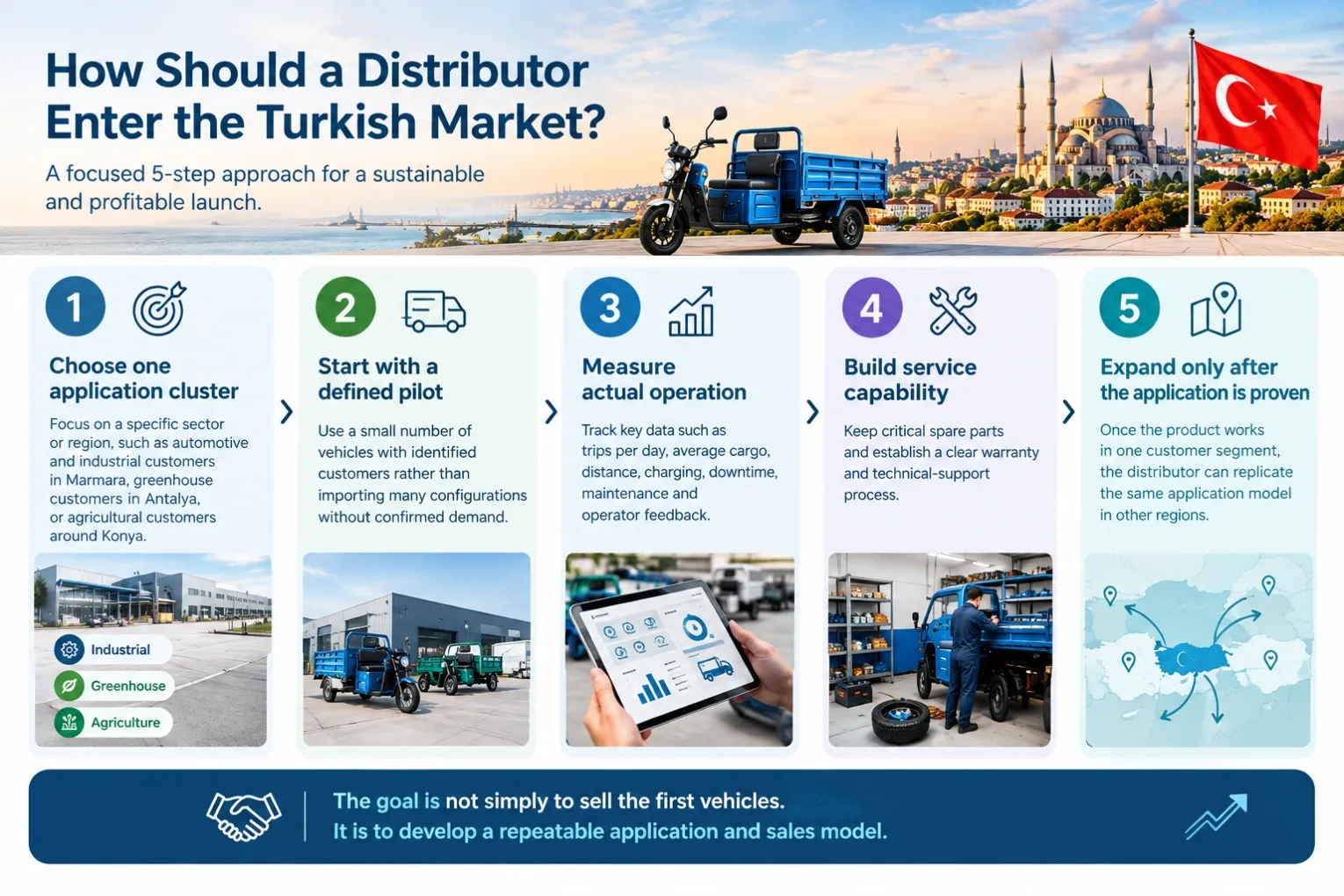
A distributor does not need to launch with a large catalogue.A more controlled approach is:
1. Choose one application cluster
For example:
- automotive and industrial customers in Marmara
- greenhouse customers in Antalya
- agricultural customers around Konya
2. Start with a defined pilot
Use a small number of vehicles with identified customers rather than importing many configurations without confirmed demand.
3. Measure actual operation
Track:trips per day,average cargo,distance,charging,downtime,maintenance,operator feedback
4. Build service capability
Keep critical spare parts and establish a clear warranty and technical-support process.
5. Expand only after the application is proven
Once the product works in one customer segment, the distributor can replicate the same application model in other regions.The objective is not simply to sell the first vehicles.It is to develop a repeatable application and sales model.
11. Turkey as a Regional Commercial Base
Turkey's location between Europe, Asia and the Middle East also creates a potential regional distribution role.The Turkish government describes the country as a strategic logistics hub connecting Europe, Africa, Central Asia and Russia, with ongoing investment in transport and logistics infrastructure.
For an electric cargo-tricycle distributor, this can support a longer-term model involving:Turkish inventory,spare-parts storage,product demonstrations,technician training,local customer support,regional shipments.Potential surrounding markets may include:Balkans,Caucasus,Central Asia,Middle East,North Africa.
But Turkey should be treated as a commercial and logistics base, not a regulatory shortcut.A vehicle accepted for Turkish use is not automatically approved for public-road use in another country.Each destination still requires its own assessment of:vehicle classification,type approval,registration,customs,technical standards,battery and shipping requirements,after-sales support.
12. Common Mistakes When Entering the Turkish Market
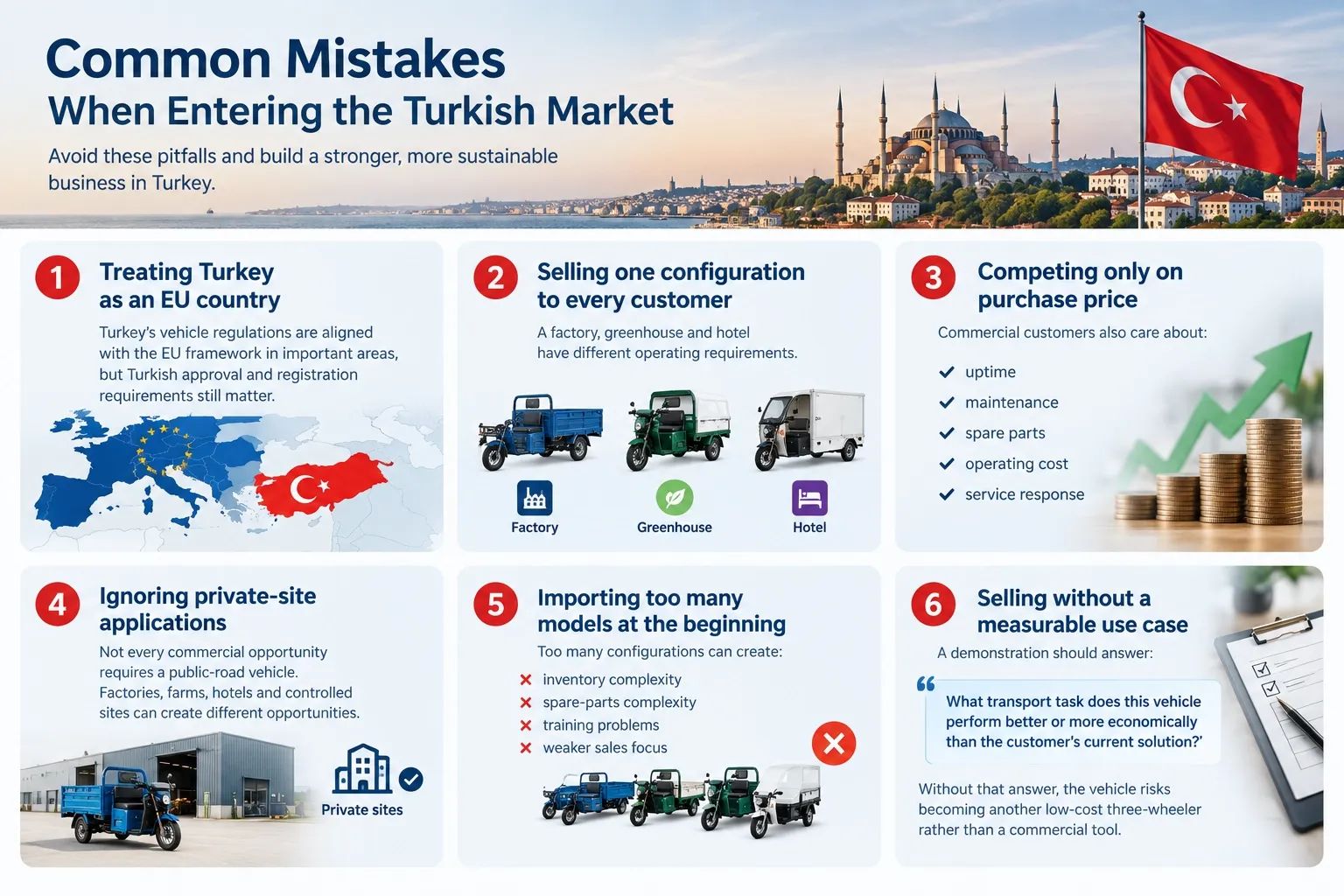
1. Treating Turkey as an EU country
Turkey's vehicle regulations are aligned with the EU framework in important areas, but Turkish approval and registration requirements still matter.
2. Selling one configuration to every customer
A factory, greenhouse and hotel have different operating requirements.
3. Competing only on purchase price
Commercial customers also care about:uptime,maintenance,spare parts,operating cost,service response.
4. Ignoring private-site applications
Not every commercial opportunity requires a public-road vehicle.Factories, farms, hotels and controlled sites can create different opportunities.
5. Importing too many models at the beginning
Too many configurations can create:inventory complexity,spare-parts complexity,training problems,weaker sales focus
6. Selling without a measurable use case
A demonstration should answer:What transport task does this vehicle perform better or more economically than the customer's current solution?Without that answer, the vehicle risks becoming another low-cost three-wheeler rather than a commercial tool.
13. Frequently Asked Questions (FAQ)
Q1: What are the primary commercial applications for electric cargo tricycles in Turkey?
A1: Electric cargo tricycles in Turkey are primarily used for short-distance internal logistics (intralogistics) within Organized Industrial Zones (OSBs), manufacturing plants, and agricultural facilities rather than long-haul road transport.
The most common operational environments include:
- OSB Manufacturing & Automotive Tier-1 Plants: Moving components, tools, packaging, and spare parts between warehouses and production lines (e.g., Kocaeli, Bursa, Sakarya).
- Greenhouses & Agriculture: Transporting harvested produce, crates, and irrigation gear across narrow aisles in Antalya, Mersin, and Konya.
- Hospitality & Resort Facilities: Carrying laundry, maintenance supplies, and waste across private hotel grounds along the Mediterranean and Aegean coasts.
Q2: Is EU Type Approval (EU Regulation 168/2013) sufficient to make an electric cargo tricycle road-legal in Turkey?
A2: No, EU Type Approval alone is not an automatic authorization for public road use in Turkey.
While Turkey's L-category vehicle regulations are harmonized with EU Regulation 168/2013 under the Ministry of Industry and Technology (Sanayi ve Teknoloji Bakanlığı), public-road operation requires local classification, a Turkish Certificate of Conformity (CoC), and mandatory registration (Ruhsat) with roadworthiness checks at TÜVTÜRK inspection stations. However, vehicles operating strictly within private industrial property, OSBs, or enclosed farms do not require public road registration, though site operators may enforce internal safety and battery protocols.
Q3: How do electric cargo tricycles compare to forklifts and small vans for factory internal logistics in Turkey?
A3: Compact electric cargo tricycles offer a high-efficiency alternative for light, repetitive internal transport tasks, delivering up to 75–80% lower operating costs compared to small diesel vans and higher versatility than forklifts.
- Compared to Small Vans: Electric tricycles significantly lower energy costs, eliminate fuel dependency, and easily navigate tight indoor/outdoor factory aisles.
- Compared to Forklifts: They are faster and far less expensive for transporting non-palletized maintenance goods, spare parts, or packaging materials across large OSB factory complexes.
- Estimated ROI: Facilities operating two shifts per day typically achieve full vehicle cost payback within 8 to 12 months due to reduced fuel and maintenance expenses.
Q4: Which Turkish regions represent the highest volume opportunities for commercial electric tricycle distributors?
A4: The highest volume commercial opportunities are concentrated in three distinct regional clusters based on Turkey's industrial and agricultural map:
- Marmara Region (Kocaeli, Bursa, Sakarya, Istanbul): Highest demand for industrial-spec cargo tricycles used in automotive supply chains, Tier-1 factories, and dense OSB warehouses.
- Mediterranean & Aegean Coasts (Antalya, Izmir, Mersin): High demand for narrow-body agricultural models for greenhouse farming and enclosed utility models for resort facility management.
- Central Anatolia (Konya): Focus on rugged farm utility vehicles suited for open-field agriculture, machinery workshops, and rural transport tasks.
Conclusion
Turkey should not be viewed simply as another European country for electric cargo tricycles.It is a distinct commercial ecosystem where manufacturing, OSBs, agriculture, logistics and tourism create different transport requirements.
The opportunity is therefore not one generic three-wheel vehicle.It is a range of short-distance commercial applications:
Factory → warehouse → production line
Greenhouse → packing area → loading point
Farm → storage → field operation
Hotel → laundry → service building
OSB → workshop → warehouse
The most practical market-entry strategy is to start with a clear transport problem, select the appropriate vehicle configuration, run a measurable pilot, establish local service capability and then expand.For distributors, the key question is not simply:
“How many electric cargo tricycles can we sell in Turkey?”
It is:“Which repetitive transport problems in Turkey can we solve better with a compact electric cargo vehicle?”
That is where the commercial opportunity begins.
Electric Cargo Tricycles in Germany 2026: A B2B Buyer’s Guide to L2e-U Utility Vehicles
Electric Cargo Tricycles in Romania 2026: Market Outlook, Regional Opportunities & Central European Distribution
For more product purchasing guidance, please read the following related articles.
How to Choose the Right Electric Cargo Tricycle for Your Business
Electric Cargo Tricycle Manufacturers in China: 2026 Sourcing Guide
How to Choose High-Quality Electric Tricycles for Internal Logistics Operations
How to Maximize Battery Lifespan in Port & Industrial Electric Tricycles: A Procurement Guide
Reducing TCO in Port Internal Logistics: How Define "High-Quality" Through Operational Certainty
Lead-Acid vs Lithium Battery: Which Is Right for Exporting Electric Tricycles?
How to Choose a Truly "Controllable" Electric Tricycle for last mile delivery
How to Make Your Electric Tricycle Run Longer: 12 Practical Maintenance Tips for Maximum Battery Life
How to Choose the Right Electric Tricycle: Port, City, and Home Applications Explained