
Sep 27, 2026Risk & Compliance
Electric Cargo Tricycles in Romania 2026: Market Outlook, Regional Opportunities & Central European Distribution
Explore Romania's commercial electric cargo tricycle market in 2026. Insights on Bucharest logistics, Timișoara manufacturing, Constanța port, and regional CEE distribution.
Electric Cargo Tricycles in Romania 2026: Market Outlook, Regional Opportunities & Central European Distribution
A B2B Market Guide for Electric Utility Tricycles
1. Romania Is More Than an Eastern European Market
Romania is one of the more strategically positioned markets for commercial electric cargo tricycles in Central and Southeastern Europe.Its opportunity is not based simply on the size of the domestic vehicle market.
Three factors are more important:
- a large agricultural and rural economy;
- rapidly expanding industrial and logistics infrastructure;
- a geographic position connecting Central Europe, the Balkans, the Black Sea and Moldova.
Romania's industrial and logistics market has expanded significantly in recent years. Modern industrial and logistics stock is approaching 8 million m², while Bucharest and its surrounding area account for more than 60% of the national stock. At the same time, regional hubs such as Timișoara, Brașov and Cluj are becoming increasingly important.
For electric cargo tricycles, this creates two separate opportunities:
Domestic market:Agriculture, industrial facilities, warehouses, construction sites, local delivery and municipal/service operations.
Regional platform:Romanian distributors can potentially serve neighboring markets including Hungary, Bulgaria and Serbia, while the country's European transport corridors connect further toward Austria, Slovakia, Croatia and other Central European markets.
This makes Romania particularly interesting for distributors that are thinking beyond a single national market.
2. Where Is the Real Market Potential in Romania?
The Romanian market should not be treated as one homogeneous market.
Commercial activity is concentrated around several different economic corridors, and the type of demand for electric cargo tricycles can vary considerably from one region to another.
A useful way to understand Romania is through five commercial zones:
Region | Main economic drivers | Potential applications |
Bucharest–Ilfov | National distribution, logistics, e-commerce, services | Delivery, warehouse logistics, facility operations |
West Romania | Automotive, manufacturing, cross-border logistics | Factory logistics, industrial parks, warehouses |
Central Romania | Manufacturing, industrial services, regional logistics | Industrial transport, agriculture, facility operations |
Constanța / Black Sea | Port, maritime logistics, trade | Port/facility logistics, warehouses, cargo handling |
Moldavia / Northeast | Agriculture, emerging logistics, infrastructure development | Agriculture, rural transport, regional distribution |
This regional approach is more useful than simply asking whether “Romania has a market for electric tricycles.”The real question is:Where are the economic activities that generate repeated short-distance cargo movements?
That is where the vehicle has a stronger commercial rationale.
3. Bucharest–Ilfov: Romania's Largest Commercial Market
Why it matters?Bucharest–Ilfov should be treated as the first market to investigate.
The region is Romania's largest concentration of logistics and commercial activity. More than 60% of the country's modern industrial and logistics stock is located within roughly an hour of Bucharest. In 2025, Bucharest accounted for approximately 75% of Romania's industrial and logistics leasing activity. The important point for electric cargo tricycles is not simply population.It is the concentration of:
- distribution centers;
- warehouses;
- e-commerce operations;
- industrial parks;
- service companies;
- facility-management operations;
- commercial campuses.
These environments create many short-distance, repetitive transport tasks.
Potential applications
An electric cargo tricycle can be used for:
- movement of goods inside large facilities;
- warehouse-to-building transport;
- maintenance tools;
- facility-management equipment;
- short-distance commercial delivery;
- industrial-site logistics;
- campus operations.
For urban delivery, the vehicle should be evaluated according to route length, cargo volume, road access and local operating requirements rather than simply comparing it with a conventional van.
4. Western Romania: Timișoara–Arad as an Industrial Gateway
This may be one of the most interesting regions for a B2B distributor, because its potential is closely connected to Western European supply chains.Timișoara and Arad sit close to the Hungarian and Serbian borders and have developed strong manufacturing and logistics ecosystems.
Timișoara is already one of Romania's major industrial and logistics hubs. In 2025 it was the country's second-largest logistics market by leasing activity, after Bucharest.
The area is particularly relevant for:
- automotive suppliers;
- component manufacturing;
- electronics;
- industrial parks;
- warehouses;
- cross-border logistics;
- production-site transport.
Why electric cargo tricycles fit this environment
Factories often do not need another road truck.They need something smaller:
- warehouse → production line
- production building → warehouse
- maintenance workshop → production area
- spare parts store → assembly area
These are repetitive, short-distance movements.An electric cargo tricycle can therefore be positioned as an intralogistics utility vehicle, rather than simply a last-mile delivery vehicle.
5. Cluj-Napoca: Technology, Services & Regional Distribution
Cluj-Napoca represents a different type of opportunity.Compared with the heavily industrial profile of Timișoara, Cluj combines:
- technology;
- services;
- manufacturing;
- regional logistics;
- commercial activity;
- a large university population.
Cluj is already identified as one of Romania's regional industrial and logistics hubs, alongside Timișoara, Brașov and other major centers. For electric cargo tricycles, the opportunity is less about heavy cargo and more about compact commercial mobility.
Potential applications include:
- facility management;
- commercial campuses;
- warehouse operations;
- maintenance services;
- local distribution;
- horticultural and municipal operations;
- industrial estates.
The compact dimensions of an L2e-U can become more valuable where the customer needs frequent movement but does not need the capacity of a conventional commercial van.
6. Brașov and Central Romania: Industry Meets Rural Economy
Brașov occupies an interesting position between Romania's industrial centers and its rural/agricultural areas.The wider Central Romania region combines:
- manufacturing;
- industrial parks;
- logistics;
- agriculture;
- forestry-related activities;
- tourism;
- regional service businesses.
Brașov, together with Timișoara and Cluj, has consolidated its position as a regional industrial hub. This creates a broader application mix.
Industrial:Short-distance factory and warehouse transport.
Agricultural:Movement of tools,feed,crates, agricultural supplies,harvested materials.
Facility operations:Maintenance, landscaping and site services.
This makes Central Romania particularly relevant for distributors offering more than one cargo configuration rather than a single urban-delivery model.
7. Constanța: Romania's Black Sea Logistics Gateway
Constanța deserves its own section because its opportunity is fundamentally different.It is not simply another Romanian city.It is Romania's major maritime gateway and forms part of the European transport network connecting the Black Sea with Central and Southeastern Europe.
The EU's TEN-T Baltic Sea–Black Sea–Aegean corridor connects Romania through Oradea, Bucharest and Constanța, while branches connect toward Timișoara, Bulgaria, Hungary and further into Central and Southeastern Europe. For electric cargo tricycles, the opportunity is mainly around controlled commercial environments:
- port-related facilities;
- warehouses;
- logistics yards;
- maintenance operations;
- industrial sites;
- short-distance cargo movement.
This is different from the urban-delivery model.The key value proposition here is:Small electric utility vehicle for repetitive internal logistics.
8. Northeast Romania: Iași, Bacău and the Emerging Moldavia Corridor
This is where the Romanian market story becomes more interesting.Historically, Northeast Romania has had weaker logistics infrastructure than Bucharest and Western Romania.However, infrastructure development is changing the commercial geography.
Recent industrial-market analysis identifies Moldavia and other eastern regions as areas with significant growth potential, supported by infrastructure development.
- Iași is particularly important as a regional economic and service center.
- Bacău can also become strategically relevant as transport infrastructure improves.
This region should therefore be viewed differently from Bucharest:not the largest market today, but a market where infrastructure development can create new logistics and distribution demand.That distinction is important for a long-term distributor.
9. Where Could Electric Cargo Tricycles Grow First?
Rather than ranking Romanian cities simply by population, it is more useful to look at economic activity + logistics infrastructure + short-distance transport demand.
Region | Market driver | Electric cargo tricycle opportunity |
Bucharest–Ilfov | Logistics & distribution | Urban/commercial logistics |
Timișoara–Arad | Manufacturing & automotive | Industrial/intralogistics |
Cluj | Technology + services + logistics | Commercial/facility operations |
Brașov | Manufacturing + rural economy | Industrial + agricultural |
Constanța | Port & logistics | Internal logistics |
Iași–Bacău | Infrastructure + regional development | Emerging logistics/agriculture |
Ploiești–Pitești | Industrial/manufacturing corridors | Factory & warehouse transport |
This gives a much more realistic picture of the Romanian opportunity than treating the entire country as one market.
10. Romania's Agricultural Market Should Not Be Ignored
Romania remains one of the more agriculturally significant countries in the EU.But the commercial opportunity is not necessarily large-scale road transportation.The more interesting use case is on-farm and short-distance agricultural transport.Examples include:
- transporting feed;
- moving tools;
- carrying crates;
- transporting harvested products;
- greenhouse operations;
- livestock-facility logistics;
- movement between farm buildings;
- maintenance operations.
This is particularly relevant because many agricultural operations involve repeated movement over relatively short distances.The vehicle therefore does not have to compete directly with a tractor or truck.
Its role can be:small, frequent and low-speed transport inside the agricultural operation.
11. Romania's EV Market: An Important Signal, but Not the Whole Story
Romania's passenger-car EV market should not be used as a direct proxy for the electric cargo-tricycle market.In 2025, Romania registered 8,833 new BEV passenger cars, while electric light-commercial-vehicle registrations reached 651 units, up from 552 in 2024. Charging infrastructure also expanded substantially.
This tells us two things.
First, commercial electrification is developing, although from a relatively low base.Second, the market remains highly sensitive to vehicle affordability, operating economics and infrastructure.
For cargo tricycles, this reinforces a practical positioning:The product should be sold as a commercial working vehicle, not simply as an EV lifestyle product.
The buyer needs to understand:
- daily operating hours;
- route distance;
- cargo requirements;
- charging conditions;
- maintenance;
- battery replacement;
- total operating cost.
The detailed European regulatory and technical framework is covered separately in our [European L2e-U guide].Likewise, detailed EU import, CoC and SKD/CKD considerations do not need to be repeated here.
12. Romania as a Regional Distribution Base
This is where Romania becomes particularly interesting from a B2B perspective.
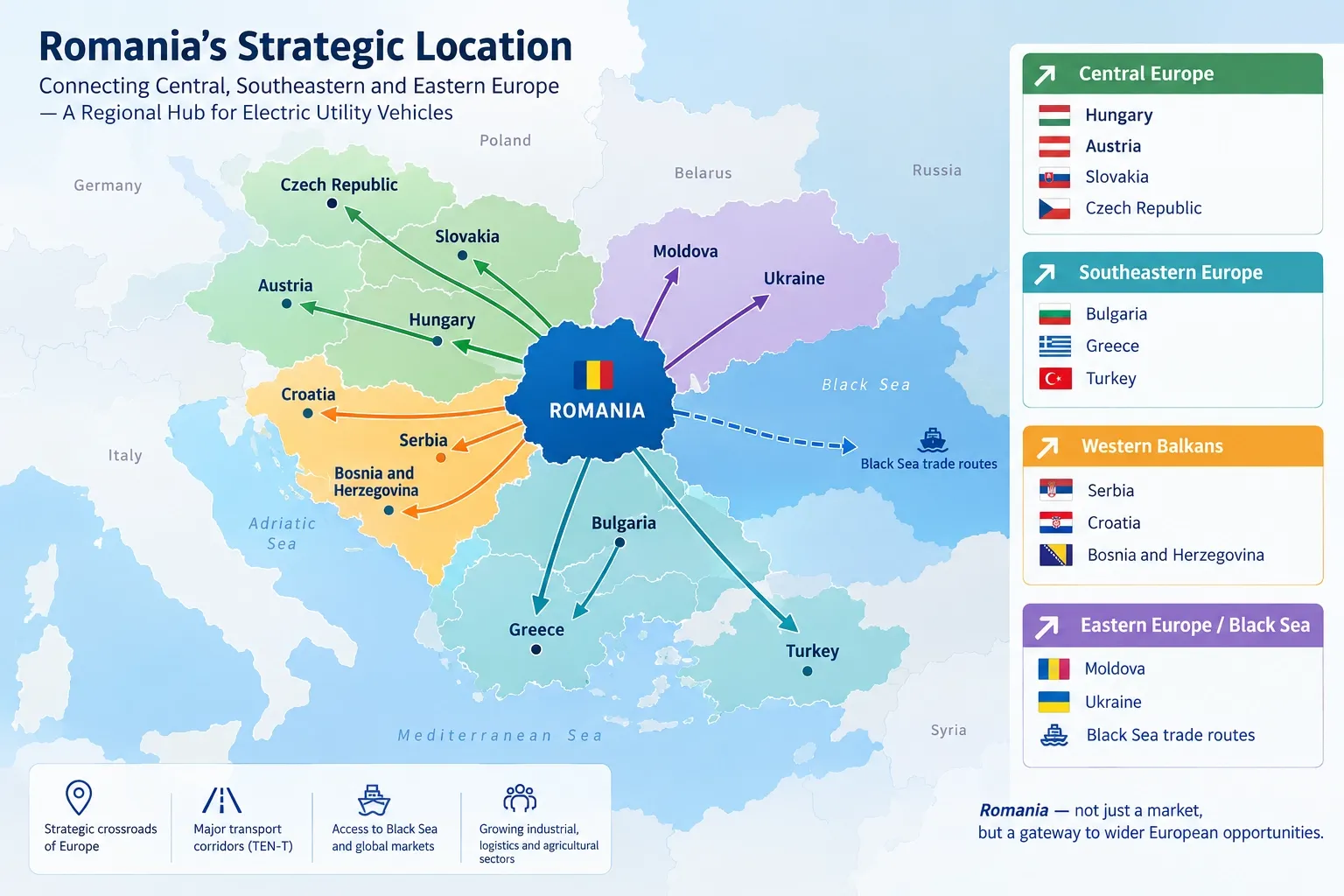
Romania is positioned between:
Central Europe:Hungary → Austria → Slovakia → Czech Republic
Southeastern Europe:Bulgaria → Greece → Turkey
Western Balkans:Serbia → Croatia → Bosnia and Herzegovina
Eastern Europe / Black Sea:Moldova → Ukraine → Black Sea trade routes
The European Commission's TEN-T network specifically identifies Romania within major corridors linking Germany, Austria, Hungary, Slovakia, Bulgaria, Croatia, Serbia and Ukraine. This creates a possible second-stage business model:Import into Romania → establish local stock/service capability → distribute to neighboring markets.
That is fundamentally different from simply selling one vehicle at a time into Romania.
13. Why Hungary and Bulgaria Are Natural Extensions
Hungary:Western Romania has a particularly strong geographic relationship with Hungary.Timișoara and Arad are relatively close to the Hungarian border, making Western Romania a logical base for serving both markets.Potential customer groups include:
- agricultural dealers;
- industrial equipment distributors;
- logistics suppliers;
- electric-vehicle dealers;
- facility-equipment companies.
Bulgaria:Southern Romania has direct geographic and transport connections with Bulgaria.Bucharest can therefore function not only as a Romanian distribution center but also as a potential gateway toward Bulgaria and further into Greece and Turkey.
The EU's Baltic Sea–Black Sea–Aegean corridor explicitly connects Romania toward Bulgaria, Greece and the Aegean ports. With Romania's integration into the Schengen area and EU single market, distributors operating from hubs like Timișoara or Bucharest can deliver SKD/CKD kits and vehicles across borders to Hungary or Bulgaria without cross-border customs delays.
14. A Possible Regional Distributor Model
For a company entering the market, the commercial model could gradually evolve:
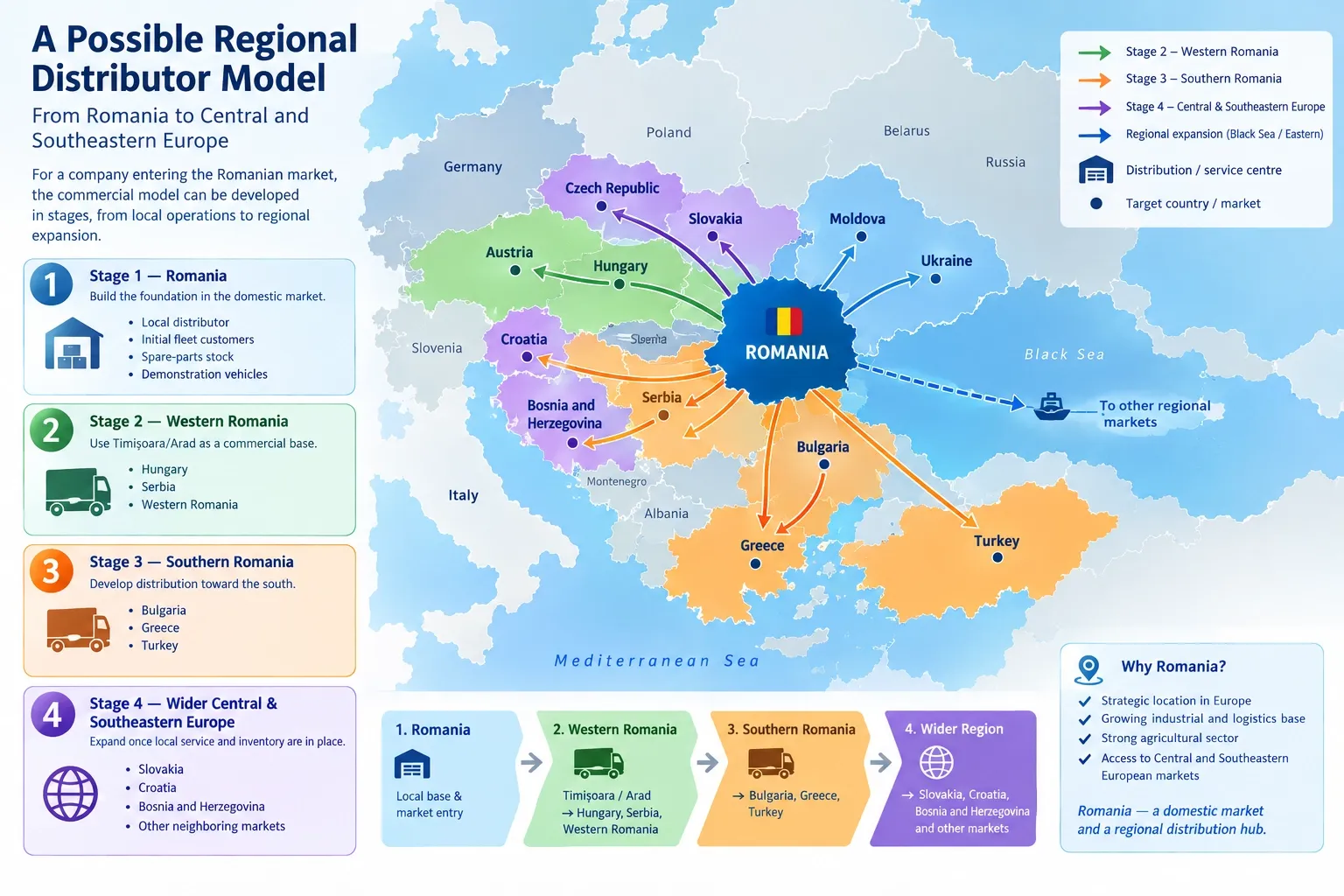
Stage 1 — Romania
Establish:
- local distributor;
- initial fleet customers;
- spare-parts stock;
- demonstration vehicles.
Stage 2 — Western Romania
Use Timișoara/Arad as a commercial base for:
- Hungary;
- Serbia;
- Western Romania.
Stage 3 — Southern Romania
Develop distribution toward:
- Bulgaria;
- Greece;
- Turkey.
Stage 4 — Wider Central & Southeastern Europe
Once local service and inventory are established, expand toward:
- Slovakia;
- Croatia;
- Bosnia and Herzegovina;
- other neighboring markets.
This should not be presented as an automatic logistics advantage. Distributor economics, customs arrangements, local registration, after-sales capability and market demand still determine whether the model works.
But geographically, Romania has the infrastructure and corridor connections to make this regional strategy commercially plausible.
15. What Type of Electric Cargo Tricycle Fits Romania?
Instead of repeating the full technical comparison from the Germany article, this article should give buyers a simple market-oriented framework.
Agricultural / Rural
Look for:
- simple open cargo bed;
- robust chassis;
- easy loading;
- good ground clearance;
- practical range;
- easy battery service.
Industrial / Warehouse
Look for:
- larger cargo platform;
- frequent-duty capability;
- weather protection;
- easy loading/unloading;
- reliable braking and suspension.
Urban / Commercial
Look for:
- compact width;
- maneuverability;
- road registration;
- appropriate EU Type Approval;
- weather protection;
- easy serviceability.
Regional Distribution
The distributor should consider:
- two or three core models;
- common parts;
- SKD capability;
- spare-parts availability;
- documentation;
- training;
- after-sales support.
The detailed L2e-U technical and regulatory framework does not need to be repeated here. See the dedicated Germany L2e-U buyer's guide for the full vehicle-category discussion.
16. Romania vs. Spain vs. Germany: Three Different Market Stories
Market | Main content angle |
Germany | Regulation, vehicle category & industrial applications |
Spain | Agriculture, tourism, ZBE & commercial urban operation |
Romania | Regional industrial growth, logistics corridors & distribution potential |
17. Romania's Strategic Position in the European Electric Utility Vehicle Market
Romania should not be viewed simply as a lower-cost alternative to Western Europe.Its more interesting role is that of a bridge market.A Romanian electric cargo-tricycle distributor can potentially combine:
Domestic demand:Agriculture + manufacturing + logistics + local commercial transport with Regional demand:Hungary + Bulgaria + Serbia + Moldova + wider Central/Southeastern Europe.
The country's industrial development, logistics infrastructure and position within European transport corridors provide the foundation for this model.
For manufacturers and distributors, this means the Romanian opportunity should be evaluated on two levels:How many vehicles can Romania absorb?and How many neighboring markets can a Romanian distribution network realistically serve?
Looking to expand your commercial EV lineup or become a regional distributor in Romania & CEE?
We offer EEC/CoC-ready L2e-U electric cargo tricycles, supporting both CKD and SKD container packaging with local spare parts support.
[ Request CEE Distributor Inquiry & Wholesale Catalog ]